
Cables are the bit of a desk setup nobody plans for. You buy the desk, you buy the chair, you arrange the monitors, and then you stand back and all you can see is… the spaghetti! A grommet hole is one of the simpler ways to fix that, and if you are commissioning a custom solid wood top from us, it costs nothing to add. Worth thinking about before you place the order though, because once it is drilled, it is drilled.
This post covers what a grommet hole actually is, when it is worth having, when it is not, what we charge for the different shapes, and how to pick a position that does not clash with your desk frame underneath.
What is a grommet hole?
A grommet hole is a hole drilled through the desk top to let cables pass from above the surface to below it without having to drape them over the back edge. Plug leads, monitor cables, USB cables, charger leads. Anything you would otherwise be tucking behind the desk and hoping for the best.
You will see them called a few different things depending on who you ask: cable management holes, wire management holes, cable pass-throughs, or just “the hole at the back of the desk”. They all mean the same thing.
When a grommet hole is worth having
Grommet holes are worth it when there is real cable traffic to manage. If you have three or more devices that need power and data leads, or a monitor arm with a clamp at the back of the desk, you also might want one. Same goes for sit/stand desks where the cables need slack to follow the top up and down without snagging.
They also help in deeper desk tops, where the back edge is too far away to reach over and retrieve a dropped lead. An 800mm+ deep top against a wall is a lot to lean across just to plug something in.
When you probably don’t need one
Not every desk needs one. If any of these apply, it might not be for you:
- The desk floats in the middle of a room with no wall behind it. Cables can simply drop off the back edge.
- The frame has no overhang at the back of the top. With nowhere for cables to drop after passing through the hole, you are just relocating the problem.
- You only ever have one or two cables on the desk. A neat cable clip on the back edge does the same job without putting a permanent hole in your top.
- You are still figuring out where everything will go. Better to live with the desk for a few months and drill the hole later, than commit to a position you regret.
What we charge: round, square and slit
Round grommet holes are free. Any size, any position, no extra charge. Just specify the diameter and where you want it in the ‘Extras’ field when you place your order request, and the workshop will drill it as part of the build.
Square holes, rectangular slots, or thin slits are all possible too, but they generally count as a custom shape and so attract a small custom shape fee (approx. £50). The fee covers the workshop time to set up the cut, since these shapes need a router or a CNC pass rather than a single hole-saw plunge. Get in touch before ordering if you have something specific in mind, and we can tell you what the addition will cost.
How big should a cable management hole be?
Grommet holes need to be wide enough to pass a UK three-pin plug through, but not so wide that they look like a portal to the carpet. The two sizes we drill most often are 60mm and 80mm in diameter.
- 60mm: fine for a handful of slim cables and a single UK plug at a squeeze. Tidier looking when not in use.
- 80mm: easier to feed multiple plugs through in one go, and a more comfortable fit for chunky power bricks. Our default recommendation if you are not sure.
- Now that many cables are detachable with USB C cables, we aree getting asked for much smaller holes too.
Grommet hole covers

Once a grommet hole is in place, you have a choice: leave it as bare wood, or fit a cover. The inside edge will be finished, so it will look in keeping with the rest of the top.
We make solid wood grommet hole covers in the same wood and finish as your top, so the cover sits flush and the join almost disappears. They turn a hole into a feature rather than a hole.
Covers are most useful when:
- The desk is in a tidy room and you want it to look unused when nothing is plugged in.
- The hole is in a visible spot rather than tucked behind a monitor.
Because of how they are turned on a lathe, our covers are made in oak or walnut to match your top. Pine is too soft to turn cleanly, so pine tops get an oak or maple cover finished to blend with the desk colour. Worth flagging if a perfect species match matters to you.
Where most people tend to drill the hole
There is no single correct spot. The right position depends on where your devices live and where the power source is. Four placements come up over and over:
Back corner(s)
The most common choice. Lets cables drop straight down to whichever side of the desk the power lives on, rather than running across the back. You can have one at either side, useful when you have separate device groups on each side, like a desk lamp and speakers on one corner and a charging dock on the other.
Back centre
Sits behind the monitor, gathers the bulk of cables in one place, looks tidy from the front. Best for setups with one or two monitors and a docking station all sitting roughly in the middle of the desk.
Side edges, near the back
Practical for desks tucked into a corner of the room, where cables would otherwise need to travel sideways to reach the wall socket. Keeps the cabling along the edge instead of cutting across your work surface.
Front corner
Less common, but the right call for desk-mounted microphones, headphone hooks, or anything you plug and unplug throughout the day. Keeps the connector close to hand without dragging a cable across the surface every time. Avoid on a small or shallow top where the hole would eat into useful working space. Perfect use case for a grommet hole cover when not in use too.
How to measure: avoid clashing with the frame
This is the bit that catches people out. The hole has to live somewhere on the top that does not sit directly above the frame, the cross beam, or the leg brackets underneath. If it does, you will end up looking down through a hole at the inside of your desk frame, which is not the look anyone is going for.
Two practical things to do before you finalise the position:
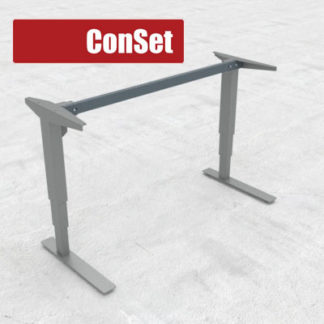
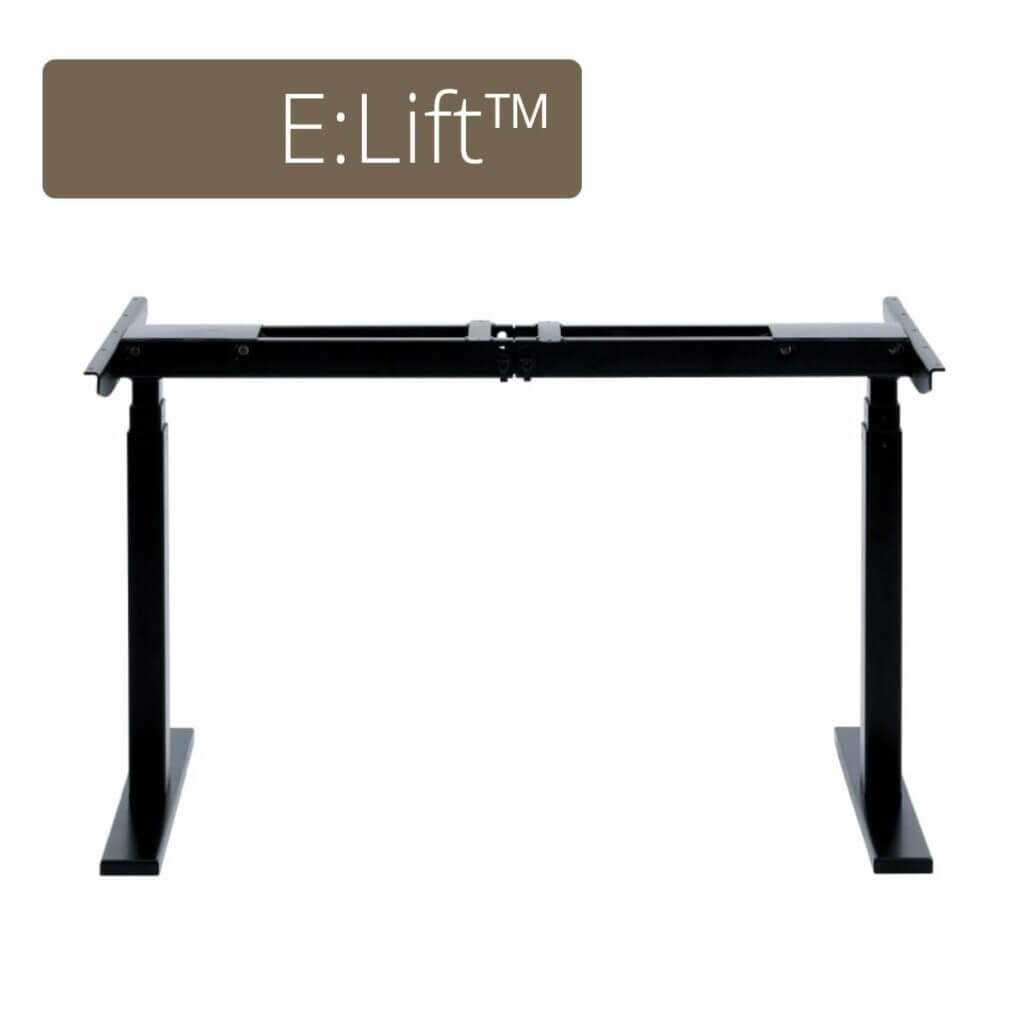
- Measure your frame’s footprint. Most sit/stand frames have a horizontal cross beam between the legs, plus mounting plates where the top bolts on. The hole needs to clear all of that. If you have the frame already, measure the gaps between the structural parts. Those gaps are where your hole can go.
- Measure from a fixed reference, not from the centre. Tell us “150mm in from the right edge, 100mm down from the back edge” rather than “in the middle”. The middle of a 1600mm desk and the middle of a 1800mm desk are 100mm apart, and that is enough to put the hole over a leg.
If your frame is a popular IKEA or Flexispot model, we already know where the structural bits live and can sense-check your position for you. If it is something more unusual, send us a photo of the frame from underneath when you place the order request, and we will let you know if anything looks too close for comfort.
Note: for tops with a rounded edge profile or a custom shape, the hole needs to clear the curve too.
Tell us when you order
Adding a grommet hole to a custom top is a one-line note in the ‘Extras’ field of your order request. Tell us the diameter, the position (measured from two edges). You can also add a matching cover on the same form if required. If you are not sure on any of it, leave a quick note saying so and we will come back with options before anything goes to the workshop.
Order requests are free and have no obligation, so it costs nothing to ask.
Why Solid Wood Tops?
Made to any size and shape.
Completely custom without the premium price tag.
Custom size? Same price.
Desk top prices are worked out using a going market rate formula. There are no extra charges for non-regular sizes. Calculate your price and order in minutes.
FAQs

Learn more about us, the quality of our partners’ sustainably sourced wood, how desk tops are priced, delivery timescales etc. Read our articles, FAQs, or chat now.
Flexible delivery options

Our trusted partners are located around the country. Allow us to arrange delivery, pick up from the workshop yourself, or book your own courier.
Money back promise

Order requests have no cost or obligation. If you do decide to confirm, you are protected if there is a problem with the size, design, quality or wood. Order with confidence.