
Sharing a desk is a bit like sharing a duvet. It works until someone takes more than their half.
A shared desk can be a good solution, especially with more than one person working from home. But there are a few more decisions to make than with a desk for one.
There’s no single right way to do it, so this post isn’t a recommendation. It’s a list of things worth considering before you place your order request. We’ll look at one top or two, how much space each person needs, where the legs go, cable management for two and what to tell us when you order.
One top or two?
One long top running the full length of the desk gives you a clean, continuous surface with no joint. It looks great, and there’s no seam/gap in the middle.
The trade-off is size. A 3000mm oak top is heavy, and it’s long. Getting it into your house can be difficult. Narrow staircases and tight landings could make it impossible, so it’s worth measuring the route into the room as well as the room itself.
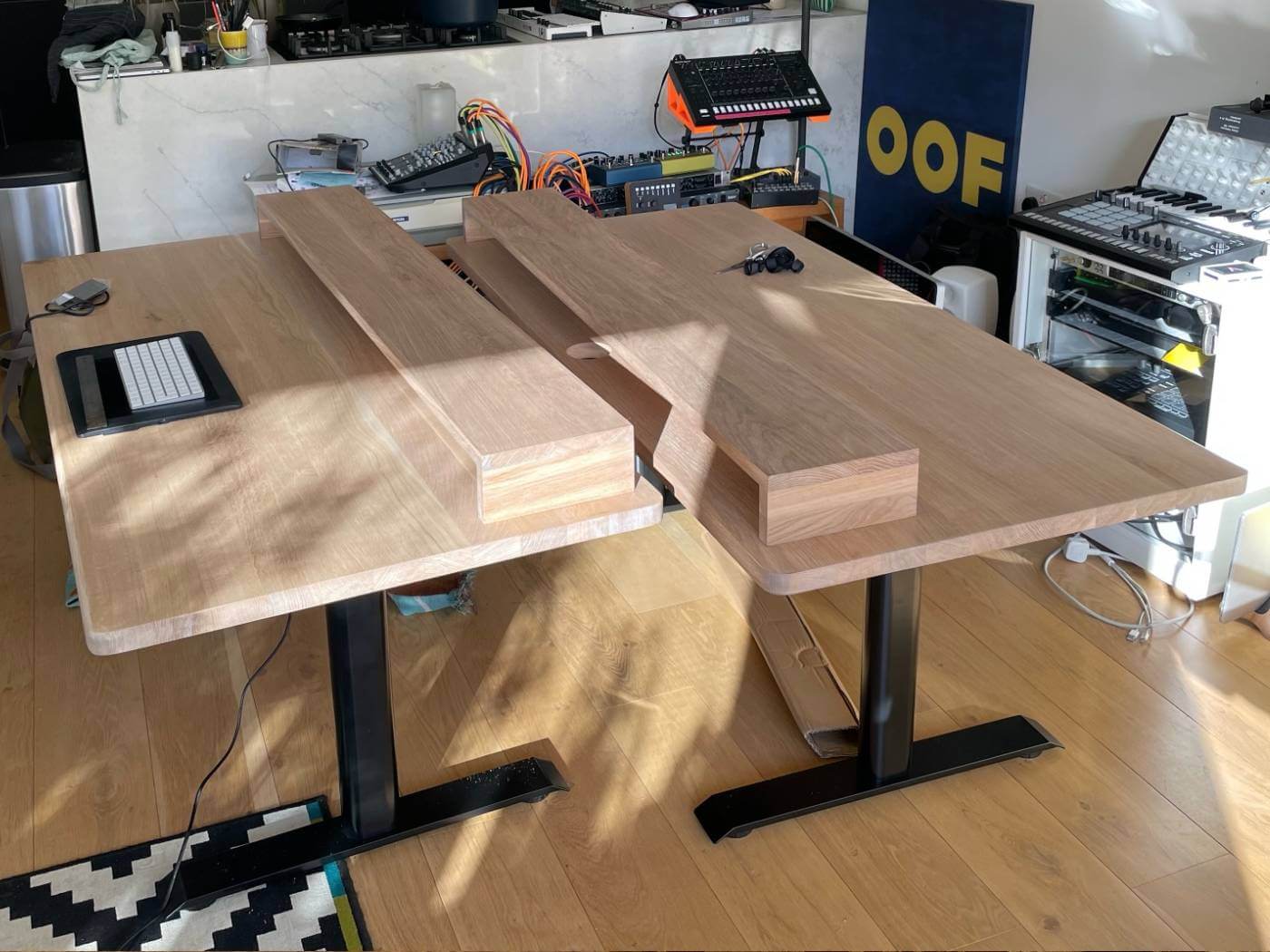
Two separate tops are easier to handle and deliver. They don’t have to be identical either. One of you might want a deeper top for two monitors while the other is happy with something shallower for a laptop. Two tops can sit side by side as they are, or be pulled together underneath (to prevent a gap) with desk top bolt connectors so they behave more like one surface. You will see a joint, but a well-made one is neat and the grain can still continue naturally.
If the room has a corner to work with, an L shape is another way to fit two people in. We’ve covered that in how to commission an L-shaped desk.
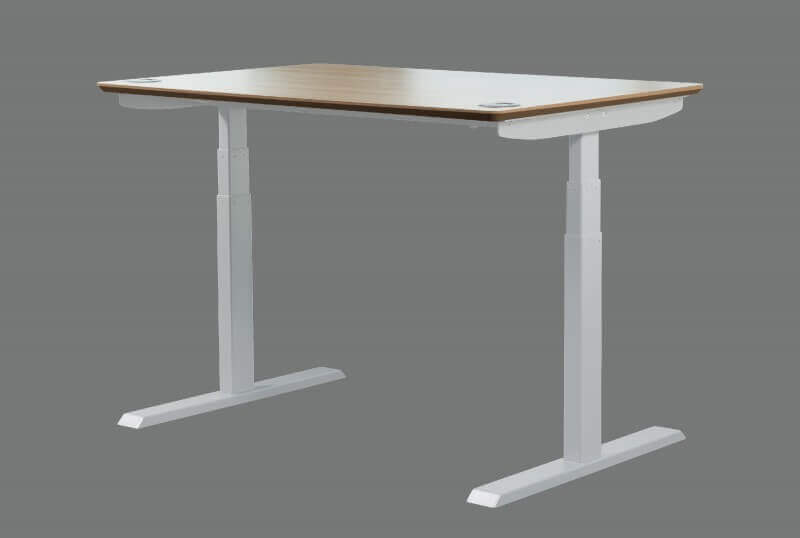
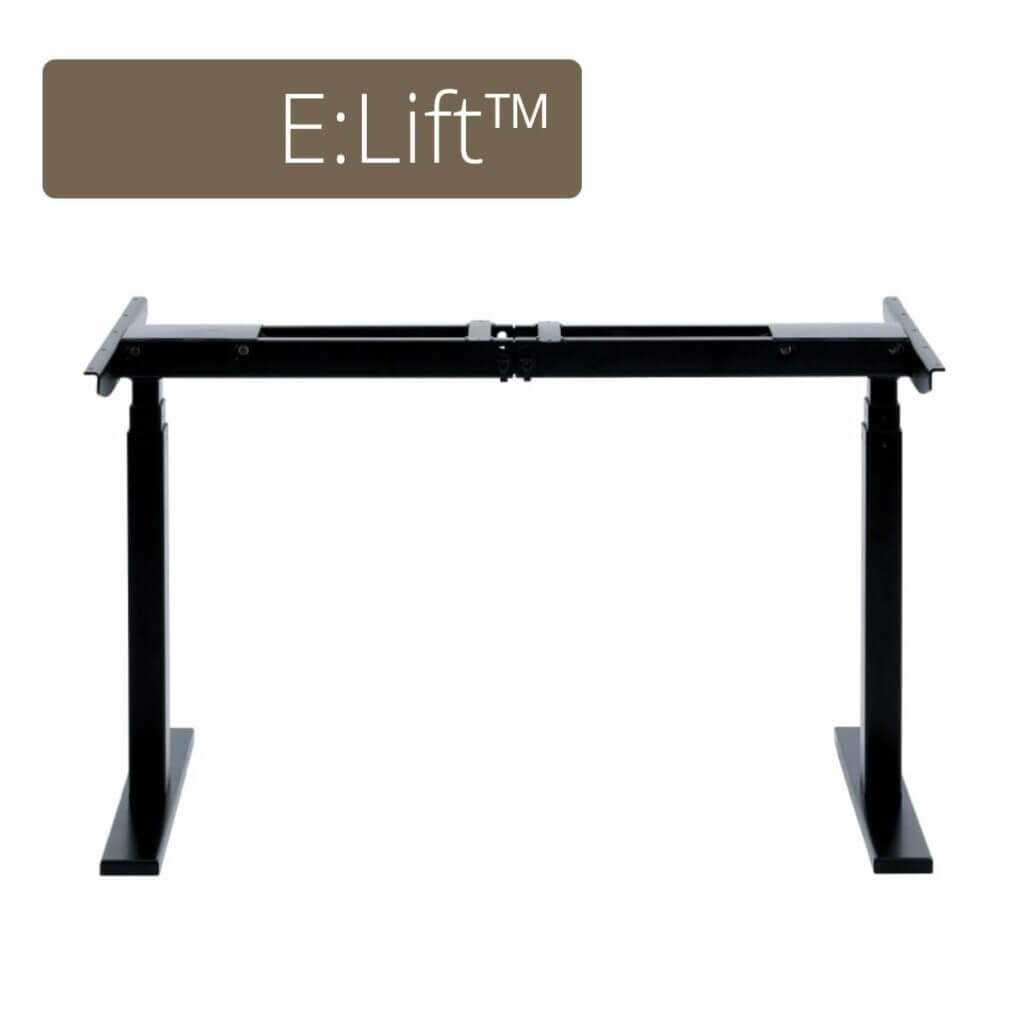
Note: if either of you wants a sit/stand desk, you’ll need two separate desks. One top can’t sit across two frames that move independently.

How much space does each person need?
As a starting point, we usually suggest 1200 to 1600mm of width per person. Put two people side by side and you’re looking at a total length of roughly 2400 to 3200mm. Depth is typically 600 to 800mm, depending on what’s on the desk.
Here’s a rough guide based on how you each work:
| Set up | Width per person | Total length | Depth |
|---|---|---|---|
| Laptop each | 1000 to 1200mm | 2000 to 2400mm | 600mm |
| One monitor each | 1200 to 1400mm | 2400 to 2800mm | 700mm |
| Two monitors each | 1400 to 1600mm | 2800 to 3200mm | 800mm |
These aren’t rules. If one of you spreads out with paperwork and the other works off a laptop, there’s no reason the split has to be 50/50. Plenty of the tops we make sit outside the standard sizes, and that’s absolutely fine. Our guide to choosing the right size goes into more detail.
Don’t forget the space behind you too. Two chairs need room to push back without hitting a wall, a bed or each other, so it’s worth leaving roughly 900 to 1000mm between the front edge of the desk and whatever is behind you.
Where do the legs go?
Legs at each end
Legs or a frame at each end keep the middle clear, but on a long top they carry a lot of weight, and the top itself might need more support in the middle depending on what you intend to put on it and the length/thickness.
A single leg in the middle
One option that saves space but still provides support is a single leg in the centre, industrial box legs work well with this type of design. It sits on the natural boundary between the two of you, so neither person has a leg in their way and you both get more space underneath.
A centre leg will often be enough for a typical shared desk, but it depends on the length, the wood and the thickness. If you’re going long, ask us. At around 3500mm we’d definitely want to check the setup with you before you commit.
No legs at all
If the desk is going into an alcove or along a solid wall, you can do away with legs completely. Battens fixed to the wall support the back edge (and the sides too, in an alcove), leaving the space underneath completely clear. It’s a really clean look, and it works well in smaller rooms.
There are a few catches. You need a solid wall to fix into, as plasterboard on its own won’t take the weight. The desk can’t be moved once it’s up, and the top needs to be thick enough to cope with the span. It’s also not an option for sit/stand.
Note: long pieces of wood need strength as well as support. For tops over 2m, we’d advise 25mm thick as a minimum, and ideally 30mm or more. Read more about how thick a desk top needs to be.
Cable management for two
Grommet holes are the simplest fix. You can have one each towards the back of your half, or one shared hole in the middle. One each keeps your cables separate, and a shared hole means fewer holes in the top. Round grommet holes are free, and you can finish them with wood grommet hole covers to match the top.
A cable tray under the desk keeps everything off the floor. You could run one long tray along the whole length or fit one each.
It’s also worth thinking about where your power comes from. A single socket at one end means one person’s cables have to travel the length of the desk. A centre leg gives a neat path down to the floor, and on a batten-mounted desk the cables can run down the wall behind.
Note: square holes, slits and other custom shapes attract a custom shape fee of approximately £50, so round grommets are usually the cheaper way to go.
Putting it all into your order request
Once you’ve got a feel for the layout, there are just a few things to let us know when you place your order request:
- One top or two
- Leg placement, or if you’d like our advice on it
- Grommet and cable tray positions, if you know them
- Wood and thickness, bearing in mind the 25mm+ guide for anything over 2m
Order requests are free and come with no obligation. We’ll match you with one of our UK workshops, you’ll get a quote, and then it’s your call. Lead times are typically 3 to 6 weeks.
Not sure what works for your space?
Every room is different, and a shared desk has a few more moving parts than most. Feel free to use our calculator to price up one top or two, and get in touch with your ideas. We’re always happy to talk it through.
Custom length Solid Wood Tops
Why Solid Wood Tops?
Made to any size and shape.
Completely custom without the premium price tag.
Custom size? Same price.
Desk top prices are worked out using a going market rate formula. There are no extra charges for non-regular sizes. Calculate your price and order in minutes.
FAQs

Learn more about us, the quality of our partners’ sustainably sourced wood, how desk tops are priced, delivery timescales etc. Read our articles, FAQs, or chat now.
Flexible delivery options

Our trusted partners are located around the country. Allow us to arrange delivery, pick up from the workshop yourself, or book your own courier.
Money back promise

Order requests have no cost or obligation. If you do decide to confirm, you are protected if there is a problem with the size, design, quality or wood. Order with confidence.